Tail water generally includes biochemical tail water and physicochemical tail water. Biochemical tail water accounts for the vast majority of the tail water, usually referring to the effluent after microbial treatment. Generally, the concentration of pollutants is relatively low and the water volume is stable, making it a good second water source. Deep treatment is a prerequisite for meeting the requirements of wastewater discharge standards or achieving water reuse. And physicochemical effluent generally refers to the effluent treated by physical and chemical methods such as oxidation, precipitation, filtration, membrane separation, etc., such as the treatment of wastewater and waste acid containing heavy metals and metals in the electroplating industry or surface treatment industry. The tailwater of these industries often contains excessive inorganic substances such as nickel, total phosphorus, and fluorine.
Case Study on Biochemical Tail Water
Taking the Biochemical Tail Water of Coking Industry as an Example
The composition of coking wastewater is complex, usually containing a large amount of stable organic compounds such as phenols, heterocycles, polycyclic aromatic hydrocarbons, etc. It is a typical high pollution and difficult to degrade industrial wastewater from coking. The effluent from this type of wastewater treated by biochemical methods contains residual organic matter, which still fails to meet increasingly strict environmental requirements for water quality indicators such as COD and ammonia nitrogen. In addition to small molecule organic compounds produced by biological metabolism, there are also some difficult to degrade aromatic and heterocyclic organic compounds, including organic compounds containing double bonds, hydroxyl groups, amide groups, nitro groups and other chromophores, and most of them also contain - NH2, - OR, - OH and other chromophores, making the color of coking wastewater still very high. Therefore, further in-depth processing is needed.
Taking the biochemical effluent of cassava alcohol fermentation industry as an example
The wastewater produced by cassava fermentation for alcohol production mainly contains sugars, proteins, vitamins, residual sugars, short fibers, and ammonium salts. After biochemical (microbial metabolism) treatment, the composition of the wastewater becomes very complex. The main components are nitrogen-containing organic compounds containing chromophores that are difficult to biodegrade, water-soluble small molecule organic compounds, ammonium salts, etc. These pollutants are the main contributors to COD and chromaticity in biochemical effluent, among which nitrogen-containing organic compounds not only produce COD but also cause high chromaticity problems, which are common issues in biochemical effluent.
Our company's biochemical effluent upgrading technology, with adsorption process as its core, is a special adsorbent and its application process developed specifically for the upgrading or reuse needs of biochemical treated effluent. The pore structure, specific surface area, and functional groups of the adsorbent are artificially controlled and designed based on common issues in biochemical wastewater. The leader of the relevant technical team has worked for several well-known foreign companies, responsible for the research and development of products, technologies, and processes related to wastewater deep treatment and reuse. The relevant technology has been industrialized and applied in many large steel and coking enterprises in China. At present, our company's related products and technologies are further upgraded based on previous related technologies, with better performance, easier operation, and lower operating costs.
The following table provides a comprehensive comparison of the main methods for deep treatment of wastewater.
Table 1 Comparison of Advanced Wastewater Treatment Technologies
| Technology | Advantages and disadvantages |
| Fenton oxidation | 1. The introduction of a large amount of iron ions into the produced water makes it difficult to control the color of the effluent, resulting in a large amount of sludge and high sludge treatment costs. The overall operating cost of the system is also high.
2. The cost of equipment maintenance is high, especially when the hardness of the air flotation effluent water in this project is relatively high. Using Fenton oxidation will result in serious equipment scaling problems.
3. It is difficult to control because the optimal ratio of hydrogen peroxide to ferrous sulfate needs to be determined through orthogonal experiments, and is influenced by the pH value of the reaction, the length of the reaction time, and the degree of stirring and mixing, making it difficult to control the ratio.
Fenton treatment is highly corrosive, and if the water quality fluctuates, modifying sewage treatment parameters can be cumbersome, affecting treatment efficiency. |
| Biochemical technology | 1. Biochemical tailwater is the effluent that has been treated with microbial technology. The residual organic matter, color, and other substances are substances that cannot be metabolized by microorganisms. Generally, the BOC/COD ratio is low and the biodegradability is poor. Further biochemical treatment is inefficient.
2. Biochemical technology has a significant amplification effect, a long debugging cycle, and many uncertain factors that affect the treatment effect.
3. Large land occupation, high investment in the entire system, unstable operating performance, and high operating costs.
The humic acid, colloidal substances, microbial particles, and microbial remains generated by the biochemical system affect subsequent RO deep treatment and water reuse. |
Double membrane method (ultrafiltration+reverse osmosis) or triple membrane method (ultrafiltration+nanofiltration+reverse osmosis) | 1. It can achieve the standard discharge or water reuse of biochemical wastewater, and the effluent is colorless. However, at the same time, it produces a large amount of high chromaticity and high COD concentrated water (concentrated water 30-55%).
2. The system investment is relatively large, and nanofiltration and reverse osmosis are easily contaminated by wastewater. The cost of replacing membrane components is high, and the overall operating cost of the system is high. |
| Special adsorption technology | 1. Special adsorbents have strong decolorization performance, high removal efficiency for colored organic matter, and can remove other pollutants such as COD while decolorizing without color reversal.
2. It can achieve stable and compliant discharge of biochemical wastewater, remove large molecular organic compounds generated by the biochemical system, and provide guarantees for the subsequent reuse of water in RO membranes.
The system has a small footprint, low investment, stable operation, easy operation, and low operating costs. |
Case Study on Physicochemical Tail Water
Taking the tail water of the electroplating industry as an example:
Electroplating wastewater generally contains various heavy metal ions, such as nickel, copper, zinc, chromium, etc., and their forms are diverse, including ionic and complex states. Usually, this wastewater is treated using methods such as oxidation, coagulation, heavy capture agent precipitation, and membrane separation. Among them, copper, zinc, chromium, etc. can meet the standard after treatment. However, nickel is often difficult to meet the standard. It is already very difficult for the treated water to stabilize at 0.3mg/L, but it still cannot meet the national requirement of ≤ 0.1mg/L. These small amounts of nickel are mainly chemical nickel, and general physicochemical methods, including conventional chelating adsorbents, are also difficult to be effective. Our company uses a self-developed special deep nickel removal adsorbent, which can achieve deep removal of nickel, including a small amount of ionic nickel in the total drainage, as well as complexed nickel that has not been treated by the previous precipitation of breaking and heavy capturing agents. It has a high concentration ratio, good mechanical strength, and minimal usage loss. In the presence of other divalent or high valent cations with the same level of ion strength, nickel ions can be preferentially adsorbed, maximizing the adsorption capacity of the adsorbent for nickel. Therefore, the regeneration cycle is longer, the operating cost is lower, and it has a higher cost-effectiveness. In addition, our company also has corresponding adsorbents for tail water containing fluorine, phosphorus, ammonia nitrogen, or total nitrogen, which can achieve deep treatment of relevant pollutants and meet relevant emission requirements.
Process route for advanced treatment of biochemical wastewater
Special Adsorption Deep Treatment Biochemical Tail Water Process:
Biochemical effluent → coagulation sedimentation → multi-media filtration → ultrafiltration (UF) or precision filtration → adsorbent →
(1) Standard emissions
(2) Reverse osmosis (RO) → water reuse
(3) Reverse osmosis (RO) → concentrated water (near colorless) → evaporative crystallization → salt recovery
Application Cases
Case 1: Biochemical wastewater from a light factory in Jiangsu cannot be discharged through pipes due to color issues. Processing requirement: chromaticity<80 times. The water quality before and after treatment is shown in the table below. Compared with the original oxidation scheme, the treatment cost is reduced by half.
Table 2 Comparison of Raw Water and Outlet Water
| Amount of water
(m³/per day) | COD
(mg/L) | Ammonia nitrogen
(mg/L) | Total nitrogen
(mg/L) | Chroma |
|
| Raw water | 7000 | ~500 | ~30 | ~100 | ~600 |
| Effluent | 7000 | 65 | 5 | 20 | 50 |
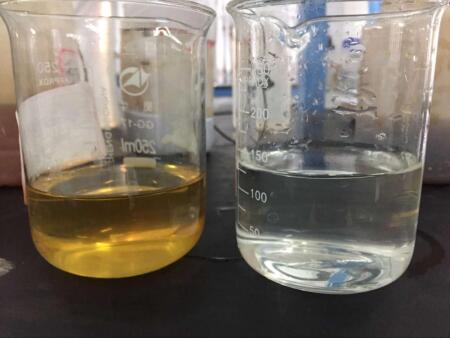
Figure 2: Raw water (left) and final effluent (right)
Case 2: A coking wastewater treatment facility in Shandong Province requires effluent COD ≤ 50 mg/L and chromaticity < 50 times. The water quality before and after treatment is shown in the table below.
Table 3 Comparison of Raw Water and Outlet Water
| COD(mg/L) | pH | Appearance |
| Raw water | ~300 | 8.2 | Pale brown |
| Effluent | 40 | 7.3 | Colourless |
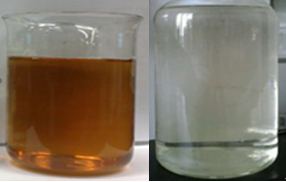
Figure 3: Raw water (left) and effluent (right)
Case 3: A certain electroplating wastewater in Jiangsu has been upgraded, and the treatment requirements are as follows: the effluent meets the industry's standard discharge requirements, and the water quality before and after treatment is shown in the table below.
Table 4 Comparison of Raw Water and Outlet Water
| COD(mg/L) | Total phosphorus(mg/L) | Appearance |
| Raw water | <240 | <8 | Canary yellow |
| Effluent | <80 | <1 | Water clear |
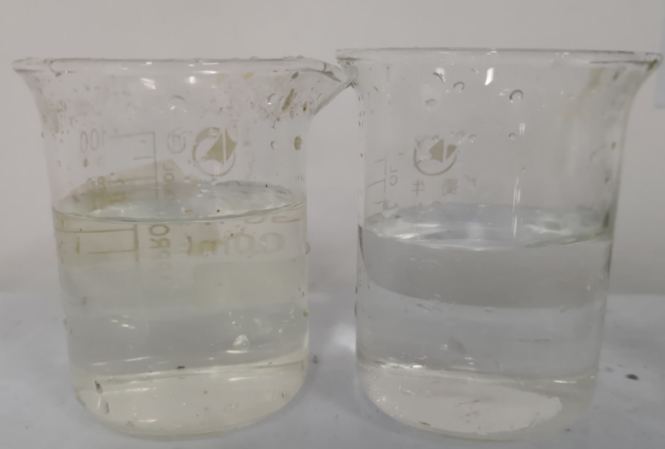
Figure 4: Raw water (left) and effluent (right)
Case 4: The production wastewater of a certain electroplating enterprise in Jiangsu mainly includes nickel, copper, chromium, zinc, etc., and most of the heavy metals exist in complex form. After being treated by physical and chemical methods such as breaking the network and precipitation with trapping agents, the copper, chromium, and zinc in the effluent can meet the relevant discharge requirements. However, nickel still has a concentration of 0.8-2.0mg/L and needs to be upgraded to ensure compliance with discharge standards.
Table 5: Before and After Processing
| Water volume (m³/d) | Nickel ion (mg/L) | Appearance |
| Raw water | 3000 | 0.8-2 | Water clear |
| Effluent | 3000 | <0.1 | Water clear |
Case 5: Fluorine containing tail water from a certain enterprise in Shandong Province. The fluoride content in the raw water is about 1.4 mg/L. According to the national emission standards, it is required to be treated to ≤ 1 mg/L.
Table 6: Before and After Processing
| Water volume (m³/d) | Fluoride ion (mg/L) | Appearance |
| Raw water | 8000-12000 | ~1.4 | Water clear |
| Effluent | 8000-12000 | <1.0 | Water clear |
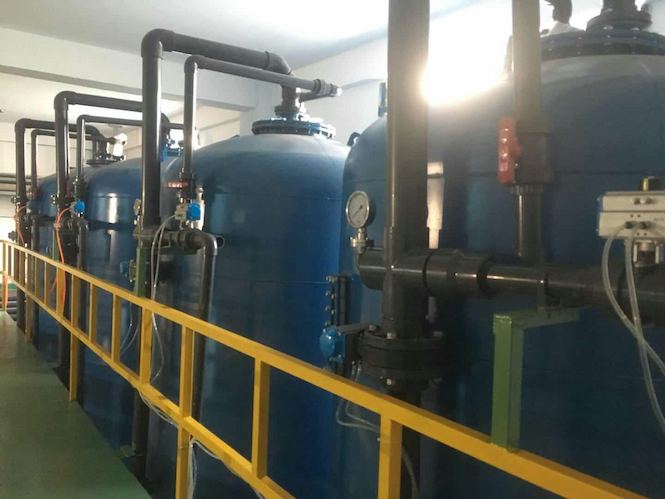
Project site

 CN
CN EN
EN
 es
es