1. Characteristics and sources of RO concentrated water treatment
In the field of coal chemical industry, a large amount of wastewater is generated every day. After undergoing some RO concentrated water treatment processes, this water ultimately passes through RO membranes, and the water produced by the membranes reaches the standard of being reusable, ultimately achieving water circulation and near zero discharge. After passing through the membranes, a certain amount of concentrated water is also produced, which is called RO concentrated water.
RO concentrated water has the characteristics of high COD, high salt content, and high chromaticity, which cannot be biodegraded again and is difficult to treat, making it a major challenge in the current coal chemical industry. The significance of researching how to treat RO concentrated water lies in the fact that the research on RO concentrated water treatment technology is an effective way to solve the problem of high salt concentrated water discharge in enterprises and promote the resource utilization of concentrated salt water in enterprises. The use of RO concentrated water crystallization by enterprises can effectively reduce or eliminate wastewater discharge, reduce environmental pollution, improve the recovery rate of RO agricultural water, reduce the consumption of fresh water in enterprises, effectively utilize low-temperature waste heat, further reduce the production cost per ton of water, and contribute to the energy-saving and emission reduction work of enterprises.
2. RO concentrated water treatment technology
The common RO concentrated water treatment methods include: improving recovery rate, direct or indirect discharge, comprehensive utilization, evaporation concentration, and removing pollutants.
2.1 Distillation Crystallization Technology Process
Distillation method is commonly used for desalination of concentrated salt water through the process of distillation crystallization. It is a desalination method, and the distillation desalination technology for industrial wastewater is basically developed based on seawater desalination technology. This technology is the process of heating saltwater to boil and evaporate it, then condensing the steam into fresh water, and further crystallizing the concentrated solution to produce salt. The main technical types of this method include multi effect evaporation, vapor compression condensation, and multi-stage flash evaporation.
2.2 Membrane Distillation Crystallization Technology
Adopting a combination of membrane distillation separation technology and evaporative crystallization. Compared with other membrane separation processes, it has the advantages of high retention rate, low energy consumption, simple equipment, and the ability to treat high concentration wastewater that cannot be treated by RO. It has the advantages of energy conservation and environmental protection. Membrane distillation crystallization is the coupling of membrane distillation and crystallization separation technologies.
Firstly, the solvent in the solution is removed during the membrane distillation process, and the feed solution is concentrated to a supersaturated state to obtain crystals in the crystallizer. During this process, the evaporation of the solvent and the crystallization of the solute are completed in the membrane module and crystallizer, respectively. This technology can utilize low calorific value waste heat, save time-consuming and low-temperature operating conditions, and have lower requirements for the mechanical properties of the membrane and equipment, which can reduce the total equipment investment and maintenance costs.
2.3 Low temperature utilization of concentrated saltwater - evaporation crystallization process
Low temperature utilization of concentrated salt water - evaporation crystallization process, using mature technology in seawater desalination engineering, reducing residual heat as a heat source, using distillation concentration process to achieve multi effect evaporation of high salt water, recovering evaporated fresh water as supplementary water, and further treating residual salt residue after evaporation crystallization as secondary waste, achieving zero discharge and reuse of high salt water.
The above methods, although feasible, have high operating costs, and especially for industries with large water volumes such as coal chemical industry, this method is difficult to implement without considering its effectiveness, with a large amount of engineering.
3. Haipu processing plan
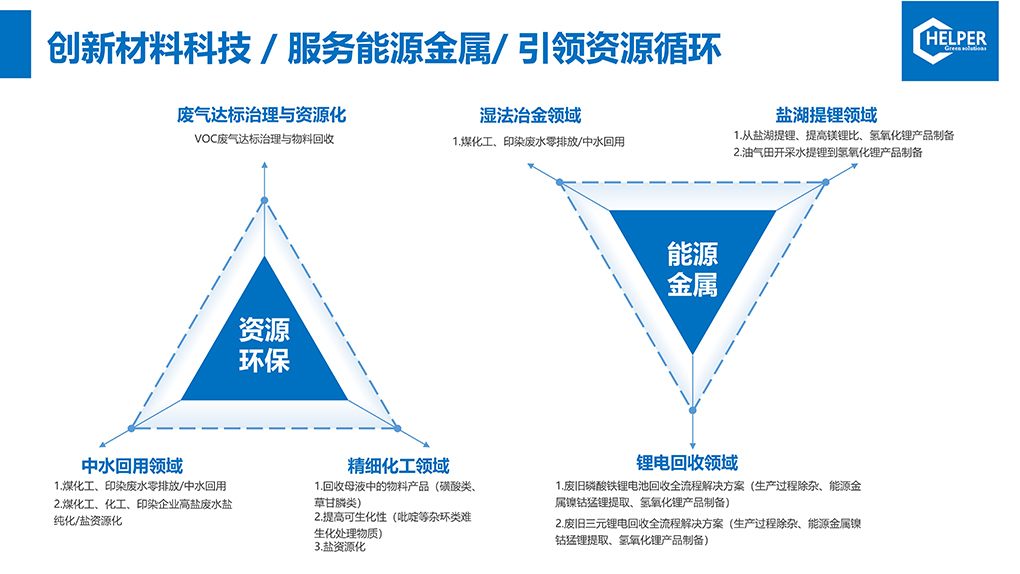
Jiangsu Haipu Functional Materials Co., Ltd. is a high-tech enterprise dedicated to the research and development of high-performance adsorbents, catalysts, and their process applications. With a series of independently developed high-performance adsorbents and catalysts as the core, combined with independently developed process technology, Haipu has become a professional solution provider in the fields of environmental governance and resource recycling. At the same time, taking it as our responsibility to help industrial enterprises meet environmental standards and achieve sustainable development through resource utilization, we adopt modular lean production and develop engineering solutions based on research and development data. Relying on independently developed high-performance adsorbents and rigorous and comprehensive process development, Haipu has accumulated many treatment cases in pesticide wastewater treatment, solving development problems for many enterprises and creating value.
Haipu high-performance adsorbent has the following advantages:
Wide applicability and good practicality
This method can be applied to wastewater concentrations ranging from a few to several thousand ppm, and the adsorption is not affected by the inorganic salts contained in the solution. It can also be applied in non-aqueous systems.
High adsorption efficiency, easy desorption and regeneration
For RO concentrated water, after adsorption, it can generally meet or approach the discharge standards, with a material adsorption rate of over 99%, without producing secondary pollutants, and can significantly reduce COD values. Common acid-base or organic solvents are used for desorption, and the desorption rate can generally reach 95%.
Stable performance and long service life
The material has high resistance to oxidation, acid and alkali, and organic solvents, and can be used for a long time below 150 ℃. Under normal circumstances, the annual material loss rate is less than 5%.
Beneficial for comprehensive utilization and turning waste into treasure
The raw material intermediates or products present in wastewater generally have higher prices. The adoption of this method can largely recycle and use, which will generate considerable economic benefits. Usually, the recycling value is equivalent to the daily operating expenses, and some have surplus.
Easy to operate and low energy consumption
Using this technology, the process is simple, no special equipment is required, the technology is easy to master, and the consumption of thermal and electrical energy is relatively low during operation.
4. Haipu Handling Case
4.1 The RO concentrated water generated in the production of a certain coal chemical enterprise is mainly high salt, high chromaticity, and high COD, with a COD of about 800-1000ppm. After treatment by the Haipu adsorption process, the chromaticity and COD in the wastewater solution are greatly reduced, and the COD is reduced to below 50ppm, thus meeting the conditions for reuse and indirectly improving the water production rate.
| Name | COD content | Colour |
| Absorb incoming water | 850ppm | Yellow |
| Adsorbed water | 48ppm | Colourless |
| Removal rate | 94.40% |
|
4.2 The concentrated water produced in the production of a certain steel enterprise is also dark in color, with COD around 680ppm. After being treated by the Haipu adsorption process, the chromaticity and COD of the water are greatly reduced, and the removal rate reaches over 90%.
| Name | COD | Colour |
| Absorb incoming water | 680ppm | Yellow |
| Adsorbed water | 35ppm | Colourless |
| Removal rate | 94.90% |
|

 CN
CN EN
EN
 es
es