In the cleavage and subsequent purification stages of peptide solid-phase synthesis (SPPS), even experienced researchers frequently encounter the following problems:
After painstakingly synthesizing a batch of crude peptides, numerous issues arise during liquid chromatography purification: peak tailing, tightly packed impurities, absurdly low recovery rates, and even column failures after only a few uses… These scenarios play out daily in peptide labs. Don't always blame your methods; the more fundamental reason might be an inappropriate selection of chromatographic packing material or improper operation.
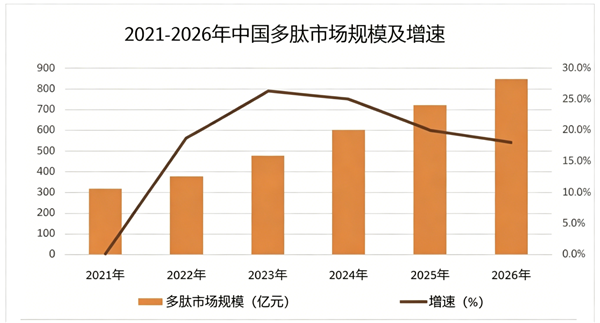
With the surging demand for blockbuster GLP-1 drugs and the expanding market for chronic disease treatment, industry requirements for the purity and yield of peptide active pharmaceutical ingredients (APIs) have reached new heights. As the "heart" of the purification process, the selection of reversed-phase chromatography packing materials has become a critical factor determining project efficiency and production costs.
Leveraging a deep understanding of solid-phase peptide synthesis supports, Hypro has launched the HC18 series of packing materials. Distinguished by excellent hydrophobic selectivity and broad versatility, these materials precisely match mainstream peptide purification systems, establishing themselves as a primary stationary phase for the field. Later in this article, we will share three practical tools—a systematic four-step purification method development strategy, a quick-reference guide for troubleshooting purification issues, and a standardized long-term column management protocol—designed to comprehensively help R&D professionals overcome purification challenges while consistently enhancing yields and process efficiency.
Selection Essentials: Four-Step Matching to Boost Method Development Efficiency
01 Determining optimal pore size based on molecular weight (critical for recovery)
<2,000 Da (short peptides): 100–120 Å is preferred. Rapid mass transfer; balances resolution and loading capacity.
2,000–5,000 Da (standard synthetic peptides): 200–300 Å. Avoids size exclusion effects; ensures high recovery.
>5,000 Da (long peptides/small proteins): 300 Å pore size.
02 Selecting the appropriate particle size based on purification scale (balancing column efficiency and backpressure)
Analytical and semi-preparative scale (μg–mg): 5 μm fully porous particles offer high plate counts; 8 μm particles allow for direct scale-up.
Preparative and industrial scale (g–100 g): 10 μm is the gold standard for Dynamic Axial Compression (DAC) columns, balancing column efficiency and backpressure.
For crude purification requiring extremely high throughput, larger particle sizes may be considered.
03 Comprehensive Chemical Environment Assessment: Matrix Types (Durability and Lifespan)
High-purity silica-based (Type B): For standard 0.1% TFA (water/acetonitrile) systems, fully end-capped, high-purity Type B silica is sufficient for over 90% of synthetic peptide purification projects. Its advantages include manageable costs, high column efficiency, and excellent batch-to-batch reproducibility.
Organic-inorganic hybrid silica: Compatible with a wide pH range (1–12); particularly suitable for peptides containing numerous basic residues or for applications requiring alkaline regeneration.
Polymer-based matrix (PS/DVB): The ultimate choice for extreme pH conditions, offering superior chemical stability.
04 Optimizing Bonded Phase Characteristics Based on Hydrophobicity and Charge (Determining Peak Shape Quality)
High-carbon-load C18: Suitable for short peptides that are highly hydrophilic and exhibit weak retention; it effectively extends the retention time window and improves impurity resolution, making it the preferred choice for standard non-polar sequences.
Low-to-medium carbon-load C18 or C8: When sequences contain a high proportion of hydrophobic residues (e.g., Trp, Phe, long-chain fatty acyl groups) and retention is predicted to be excessive, reducing the carbon load allows the elution gradient to be adjusted to an optimal solvent range, thereby avoiding difficulties in lyophilizing large solvent volumes and preventing a decline in selectivity.
Full End-capping and Surface Charge Modification: Basic peptides rich in Arg and Lys are prone to peak tailing caused by residual silanol groups—an issue that carbon load alone cannot resolve. High-quality end-capping or the use of hybrid C18 phases with a positive surface charge is essential to suppress ion-exchange interactions at the stationary phase interface, ensuring symmetrical peak shapes and stable yields.
HaiPu HC18 Series: Covering diverse purification scenarios
Haipu New Materials’ HC18 series addresses key challenges in peptide purification—specifically the wide range of molecular weights and significant differences in hydrophobicity and charge—by offering a comprehensive product portfolio spanning various pore and particle sizes. This range enables rapid method development and industrial-scale batch reproducibility for applications extending from the efficient preparation of standard short peptides to the high-purity, low-tailing purification of basic long peptides.
Excellent batch-to-batch reproducibility
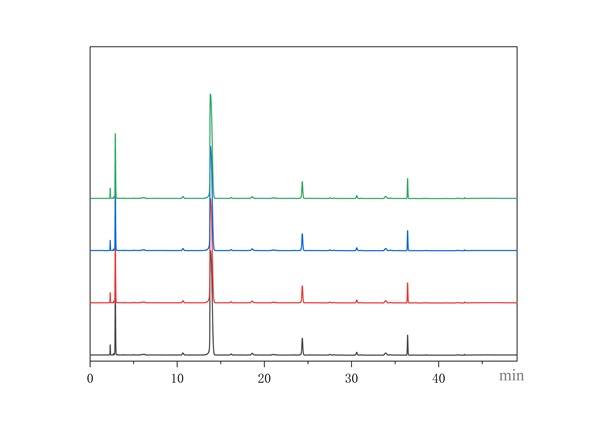
Test results for the separation performance of four batches of packing material show that the relative standard deviation (RSD) of key parameters is strictly controlled within the 1%–2% range, ensuring the long-term stability of the fermentation and purification process at the material level.
Industrial grade super long life
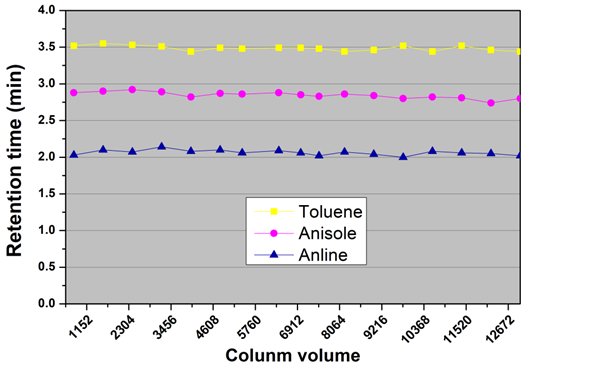
Under continuous industrial operating conditions, the packing maintains over 95% of its column efficiency and exhibits less than 5% degradation in loading capacity. Its industrial-grade durability has been validated through rigorous testing, significantly reducing packing replacement costs and meeting the demands of large-scale continuous production.
Parameters for Selected Common HC18 Series Products
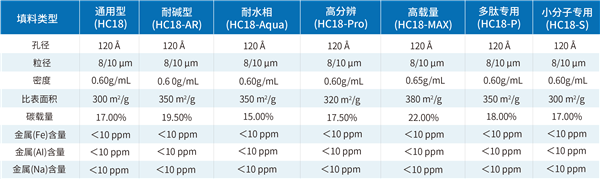
*Please feel free to contact us for more information about trials or products.
[Quick Reference Guide]:Common Purification "Disasters" and Remedial Measures
During the actual purification process, if fluctuations in separation performance are encountered, the following technical aspects can be consulted for troubleshooting and optimization:
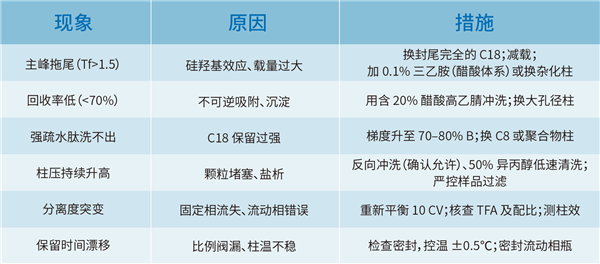
Safety tips: TFA is highly corrosive and must be operated in a fume hood, wearing acid-proof gloves and goggles; acetonitrile waste liquid is recycled in a special bucket.
Standardized Management of Chromatographic Column Lifespan
Before starting each project, use standards to record the number of plates and symmetry factors, and establish a column efficiency baseline file. When the number of plates drops to 70% of the new column or the resolution does not meet the requirements, it is recommended to regenerate according to the following process:
1. Acidic wash: Gradient wash from 0.1% TFA in water to 0.1% TFA in acetonitrile.
2. Organic wash: Wash with isopropanol/acetonitrile (50:50) for 10 column volumes (CV).
3. Silica-based columns must not be exposed to strong bases;hybrid/polymer-based columns may be washed with 0.1 M NaOH.
4. Test with a standard sample after regeneration; resume use for production or R&D only after successful validation.
Professional Technical Support
If you encounter challenges during method development or process scale-up, we can provide tailored purification strategy recommendations and trial packs from the HC18 series. Please contact our technical support team for a one-on-one consultation.

 CN
CN EN
EN
 es
es