Anhui, as a water scarce province, will take policy measures to expand the ways of sewage recycling and utilization, formulate relevant technical standards for the use of recycled water, and expect the utilization rate of recycled water in water scarce cities in the province to reach over 25% by 2025.
During the 14th Five Year Plan period, the province plans to add 800000 tons/day of recycled water utilization facilities.
Promote the utilization of recycled water resources
In recent years, Anhui Province has actively promoted the construction of urban recycled water utilization facilities, introduced relevant laws and policies, and focused on improving the efficiency of sewage recycling, achieving certain results.
In order to promote the construction of recycled water utilization facilities, Anhui Province reasonably determines the scale and layout of recycled water utilization facilities and supporting pipeline networks in accordance with the principle of "centralized utilization as the main and decentralized utilization as the auxiliary", combined with the water shortage nature, user needs, and utilization pathways of water deficient cities.
During the 13th Five Year Plan period, the province added 830000 tons/day of recycled water utilization, exceeding the planned task. According to statistics, the utilization rate of recycled water in water scarce cities such as Hefei has exceeded 20%.
At present, the utilization of recycled water in Anhui Province is still in its infancy, with insufficient development and low utilization level. There are problems such as incomplete infrastructure for the supply of recycled water, low water quality standards for recycled water, and weak constraints on the use of recycled water.
Therefore, during the 14th Five Year Plan period, the province plans to add 800000 tons/day of renewable water utilization facilities. Fully utilize the tail water discharged by sewage treatment plants to replace conventional water resources with recycled water, which is used for urban road cleaning, green space irrigation, and ecological water replenishment in rivers.
Establish sound standards and technical selection for the construction of reclaimed water reuse facilities
The utilization of recycled water is an important way to achieve optimal allocation of water resources, promote sustainable development, utilization, and protection of water resources.
Anhui is a water scarce province, and effectively utilizing sewage resources is of great significance for optimizing water supply structure, increasing water resource supply, and ensuring water ecological security. Next, the Provincial Department of Housing and Urban Rural Development will work together with relevant departments directly under the province to do a good job in the utilization of recycled water and sewage resources.
Among them, by improving the policies for the use of recycled water, relevant departments directly under the provincial government will jointly formulate and implement plans to promote the utilization of sewage resources in Anhui, further establish and improve standards for the construction of reclaimed water reuse facilities, open up government pricing for recycled water, and implement current relevant tax policies.
In terms of the reuse of reclaimed water at the level of chemical enterprises and industrial parks, since the 13th Five Year Plan, the country has attached increasing importance to ecological environment protection, and the standards for wastewater discharge and the total control of regional wastewater discharge have become increasingly strict. The 13th Five Year Plan clearly states that by 2020, the total emissions of chemical oxygen demand, ammonia nitrogen, sulfur dioxide, and nitrogen oxides in China will be controlled within 20.01 million tons, 2.07 million tons, 15.8 million tons, and 15.74 million tons, respectively.
Therefore, after the second half of 2017, the pollution discharge standards of existing chemical industrial parks will be stricter.
This is also a problem that must be faced in the process of using recycled water. With high standards, how can enterprises efficiently achieve the goal of using recycled water?
Table 1-1 Upgrading of Main Indicators for Emission Standards in Chemical Industrial Parks
| Name | SS(mg/L) | Ammonia nitrogen (mg/L) | COD(mg/L) | BOD(mg/L) | Petroleum (mg/L) |
| Emission Standards for Pollutants from Inorganic Chemical Industry GB31573-2015 | 50 | 10 | 50 | / | 3 |
| Pollutant Emission Standard for Synthetic Resin Industry GB31572-2015 | 30 | 8 | 60 | 20 | / |
| Emission Standards for Pollutants from Petrochemical Industry GB31571-2015 | 70 | 8 | 60 | 20 | 5 |
| Emission Standards for Pollutants from Petroleum Refining Industry GB31570-2015 | 70 | 8 | 60 | 20 | 5 |
Some large water users such as printing and dyeing, coal chemical enterprises often fail to meet the reuse standards due to excessive COD in the biochemical effluent.
The elements contained in such organic wastewater are often complex in composition. The treatment methods adopted for organic wastewater in China mainly include incineration, adsorption, Fenton oxidation, biological method, iron carbon microelectrolysis method, and photocatalytic oxidation method.
However, the current treatment methods for COD wastewater reuse have their own shortcomings in terms of treatment effectiveness and operating costs. Adsorption method can effectively remove COD from wastewater below the reuse standard, making it an economical and effective method for treating COD wastewater.
When using Haipu's adsorption process to treat COD wastewater, the wastewater is pre filtered to remove suspended and particulate matter, and then enters the adsorption tower for adsorption. The special adsorption material filled in the adsorption tower can adsorb the organic matter in the wastewater on the surface of the material, ensuring that the effluent continues to meet the discharge standards. After adsorption saturation, specific desorption agents are used to desorb the adsorbent material, allowing it to regenerate, and this process is continuously repeated.
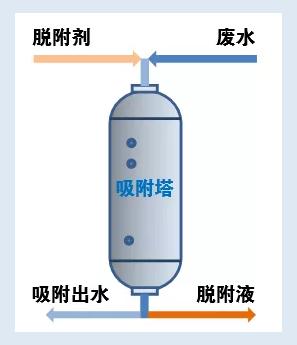
*Adsorption principle
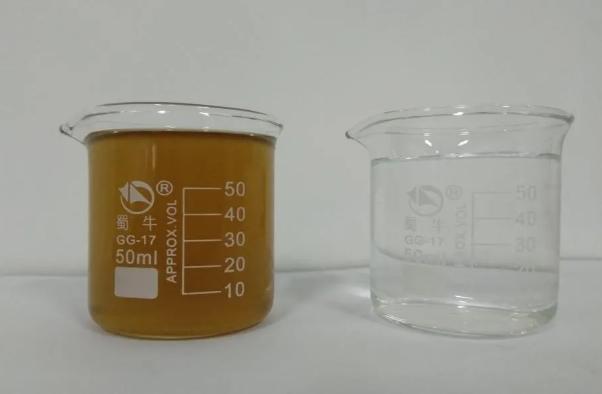
*Appearance of raw water (left) and treated effluent (right)
The 1000t/d COD containing wastewater water reuse project of a certain printing and dyeing enterprise adopts the Haipu adsorption process to treat the COD containing wastewater generated during its production process.
| Project | Raw water COD (mg/L) | Effluent COD (mg/L) |
| 1 | 164 | 40.5 |
| 2 | 164 | 42.3 |
| 2 | 164 | 41.4 |
From the results, it can be seen that the COD removal rate remains stable at over 80%, and the effluent COD is much lower than the customer's requirement (<50mg/L).
The raw water is brown in color, and the effluent is basically colorless and clear. Most of the organic matter in the wastewater is removed. Experiments have shown that adsorption removal of COD in wastewater is an effective treatment method.
The treated wastewater can be directly reused, greatly reducing the environmental pressure on enterprises and complying with environmental policies.
Prioritize water conservation and promote high-quality and cost-effective recycled water.
In the future, Anhui will actively play the role of guiding and supporting provincial financial funds, and increase the efforts to obtain central special funds for the use of recycled water resources and local financial investment.
Include industrial water-saving and recycled water reuse renovation projects in the scope of financial support for manufacturing strong provinces, provide one-time rewards for key projects that meet the conditions, guide enterprises to carry out green and high-quality transformation and upgrading and circular transformation with water-saving as the key content, encourage high water consuming enterprises to strengthen the deep treatment and standard reuse of wastewater, and improve water use efficiency.
Meanwhile, looking at the whole country, water scarcity has become a prominent bottleneck constraint for sustainable economic and social development. Efficient and rational utilization of water resources has become an important part of China's sustainable economic and social development and ecological civilization construction.
In addition to relevant policies in various regions, the "Guiding Opinions on Promoting the Utilization of Wastewater Resources" jointly issued by ten ministries in January 2021 also mentioned the need to accelerate the utilization of wastewater resources, promote the overall management, scientific allocation, comprehensive conservation, and circular utilization of water resources.
Effective reuse of reclaimed water at the enterprise and park levels is a mutually beneficial approach that not only saves water but also has practical effects in controlling pollution, resulting in significant social and economic benefits.

 CN
CN EN
EN
 es
es